Saturday, June 20, 2009
A Couple of Favorite Quotes
Well, for a while there I was bad about posting because I was sick and not painting and had nothing to say. Now I'm feeling better, but I haven't been posting because I've been swamped meeting deadlines after two months of getting nothing done! If it's not one thing, it's another I suppose.
Anyhow, I just wanted to pass along a couple of quotes by William Wendt that I wrote down when I was reading through the catalog for last year's show at the Laguna Museum. Wendt is one of my favorite landscape painters, and I would have loved to see the show. Alas, I have to be happy with the catalog, which, luckily, is fantastic.
"Nature had more to say than can be caught in a minute, she has lessons for us that may take a lifetime in the learning and I believe she intended that we landscape painters should mix brains with our paint."
I love how he speaks of landscape painting as a lifetime endeavor, and dismisses the idea that it isn't intellectual. I also love this one, which explains so well why I love wilderness and landscape painting:
"Here, the heart of man becomes impressionable. Here, away from conflicting creeds and sects, away from the soul-destroying hurly-burly of life, it feels that the world is beautiful, that man is his brother, that God is good."
Sunday, June 14, 2009
Photographing Oil Paintings
Photography ranks near the top of the list of things I don't like about my job. Getting good photographs of my paintings has frustrated me since the day I started painting. Unfortunately, the further I get in my career, the more important it is to have quality images of my paintings.
I used to have a perfect spot in my house to photograph my paintings - indirect light, no glare, just perfect. Then we moved (three times), and every time we moved I found myself scrambling to find a new "perfect" spot.
I've tried every spot in the current house with indirect light, shooting outside on a cloudy day, shooting outside on a sunny day, shooting inside the studio with my daylight flourescents, shooting my paintings at an angle, and whatever else you might suggest. No matter what, I seem to end up with glare on some part of the painting. I use thick paint, and I find it next to impossible to to take a photo without the light catching on some brushstroke, and it drives me insane. For big paintings, it's not a big deal - hardly noticeable unless you blow up the painting full size. For small paintings, or paintings with a lot of dark values, it can make getting a decent image virtually impossible.
So, I started looking into having my paintings professionally photographed last year. Problem is, most photographers who know anything about photographing 2D art charge $50-$70 per painting, which adds up quickly if you're at all prolific. Also, I live in the mountains, so add in the hassle of transporting my paintings two hours to a photographer in Denver, then having to make the same trip to pick them up. I'm cheap, so this doesn't really appeal to me - I'll probably only do this if I ever start to make giclees or prints.
A few weeks ago, Carole Marine recommended this new ebook called "Exposing Yourself: The Artist's Guide to Digital Imaging". It's written by Jason Smith, a photographer who does all the photography for the Greenhouse Gallery in San Antonio, TX (if you want to see his work, just go click on the high res image of any painting on their website). Every year I'm impressed with the images of my paintings that show up on the Greenhouse Gallery website for the Salon International show, so I figured I could probably learn a thing or two from him and bought the book.
The book covers everything from cameras to lighting to computer editing and printing, but I was mostly focused on the lighting. Like most of the local photographers I've talked to, Smith recommends using polarizing filters on the lights and camera to eliminate glare. Unlike most of the photographers I've talked to, he actually explains how to do this in enough detail that I was able to order the equipment and try it myself!
So, long story short, it worked. I'm actually totally impressed at how easy this was after all my frustration over the past few years. The picture I put up with my last blog post is the poster child for all of my frustration.
Here's the "before" shot:
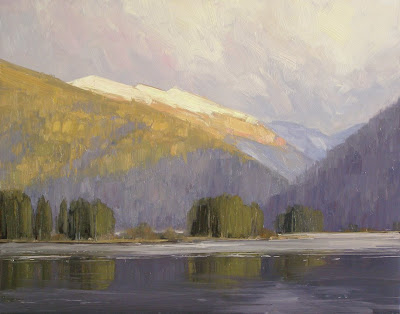
If you click to enlarge it, you can see that I had some serious glare on anything resembling a vertical brushstroke. It looks okay small, but full size it's fairly atrocious. And since it's a small painting (11x14"), it's really obvious that the photo is lacking.
Here's my "after" shot (click to enlarge):
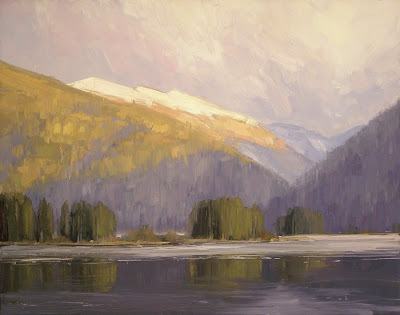
You probably have to see these images full-screen to really see the difference. First of all, NO glare - yay!! Second of all, more saturated color and accurate values. I took this photo and uploaded it to my computer and immediately felt that every penny I had spent on lighting and filters had been worth it (and wished I had figured this out two years ago).
Also, for the record, the "before" photo took me about half an hour and twenty photos to get the quality you see here. The "after" photo was my first shot after setting up the new lights - that's about 29 minutes worth of frustration avoided! This is just an average example, but I've had some paintings with darker values that were a nightmare to photograph without having glare messing up the values, and I can tell just from this photo that this setup will solve those problems completely.
Overall, I had to spend about $270 on equipment. I bought a polarizing lens for my camera, an adapter for the lens since my camera isn't an SLR, lights, bulbs, stands, polarizing filters for the lights, and filter holders for the lights. That cost translates to the price of having about five paintings professionally photographed, so I figure it'll pay for itself quickly. Also, now that I know I can successfully eliminate the glare myself, I'll feel more justified in eventually buying that nice new DSLR that I've had my eye on for a while!
Anyhow, I just wanted to share this, and say that if you have any questions about photographing your paintings or editing the digital files, I'd highly recommend getting Smith's book, Exposing Yourself. It's a simple upload, and worth every penny at only $19.95.
Now, if you'll excuse me, I'm going to go re-photograph every painting in my studio!
I used to have a perfect spot in my house to photograph my paintings - indirect light, no glare, just perfect. Then we moved (three times), and every time we moved I found myself scrambling to find a new "perfect" spot.
I've tried every spot in the current house with indirect light, shooting outside on a cloudy day, shooting outside on a sunny day, shooting inside the studio with my daylight flourescents, shooting my paintings at an angle, and whatever else you might suggest. No matter what, I seem to end up with glare on some part of the painting. I use thick paint, and I find it next to impossible to to take a photo without the light catching on some brushstroke, and it drives me insane. For big paintings, it's not a big deal - hardly noticeable unless you blow up the painting full size. For small paintings, or paintings with a lot of dark values, it can make getting a decent image virtually impossible.
So, I started looking into having my paintings professionally photographed last year. Problem is, most photographers who know anything about photographing 2D art charge $50-$70 per painting, which adds up quickly if you're at all prolific. Also, I live in the mountains, so add in the hassle of transporting my paintings two hours to a photographer in Denver, then having to make the same trip to pick them up. I'm cheap, so this doesn't really appeal to me - I'll probably only do this if I ever start to make giclees or prints.
A few weeks ago, Carole Marine recommended this new ebook called "Exposing Yourself: The Artist's Guide to Digital Imaging". It's written by Jason Smith, a photographer who does all the photography for the Greenhouse Gallery in San Antonio, TX (if you want to see his work, just go click on the high res image of any painting on their website). Every year I'm impressed with the images of my paintings that show up on the Greenhouse Gallery website for the Salon International show, so I figured I could probably learn a thing or two from him and bought the book.
The book covers everything from cameras to lighting to computer editing and printing, but I was mostly focused on the lighting. Like most of the local photographers I've talked to, Smith recommends using polarizing filters on the lights and camera to eliminate glare. Unlike most of the photographers I've talked to, he actually explains how to do this in enough detail that I was able to order the equipment and try it myself!
So, long story short, it worked. I'm actually totally impressed at how easy this was after all my frustration over the past few years. The picture I put up with my last blog post is the poster child for all of my frustration.
Here's the "before" shot:

If you click to enlarge it, you can see that I had some serious glare on anything resembling a vertical brushstroke. It looks okay small, but full size it's fairly atrocious. And since it's a small painting (11x14"), it's really obvious that the photo is lacking.
Here's my "after" shot (click to enlarge):

You probably have to see these images full-screen to really see the difference. First of all, NO glare - yay!! Second of all, more saturated color and accurate values. I took this photo and uploaded it to my computer and immediately felt that every penny I had spent on lighting and filters had been worth it (and wished I had figured this out two years ago).
Also, for the record, the "before" photo took me about half an hour and twenty photos to get the quality you see here. The "after" photo was my first shot after setting up the new lights - that's about 29 minutes worth of frustration avoided! This is just an average example, but I've had some paintings with darker values that were a nightmare to photograph without having glare messing up the values, and I can tell just from this photo that this setup will solve those problems completely.
Overall, I had to spend about $270 on equipment. I bought a polarizing lens for my camera, an adapter for the lens since my camera isn't an SLR, lights, bulbs, stands, polarizing filters for the lights, and filter holders for the lights. That cost translates to the price of having about five paintings professionally photographed, so I figure it'll pay for itself quickly. Also, now that I know I can successfully eliminate the glare myself, I'll feel more justified in eventually buying that nice new DSLR that I've had my eye on for a while!
Anyhow, I just wanted to share this, and say that if you have any questions about photographing your paintings or editing the digital files, I'd highly recommend getting Smith's book, Exposing Yourself. It's a simple upload, and worth every penny at only $19.95.
Now, if you'll excuse me, I'm going to go re-photograph every painting in my studio!
Thursday, May 28, 2009
Working Hard or Hardly Working?
My fortune at the Chinese restaurant last night said, "Chance favors those in motion." I read it to my husband and we both laughed - after all, I've spent the last few months trying to move as little as possible!
Isn't this common sense, though? I think of it as "making luck" - making the effort required to position ourselves where we can take advantage of new opportunities. I'm painfully aware that when I'm not working, I'm not in a position to go anywhere with my art but down. The more effort I put into making and selling my paintings, the more likely I am to get results. Being an artist is not an easy job - it requires commitment and elbow grease.
Alyson Stanfield touched on this in her Deep Thought Thursday blog last week, asking her readers how many hours per week an artist should devote to his or her career, referencing Michael Shane Neal's suggestion of 12-18 hour days.
I usually love reading the responses to Alyson's Thursday questions, and this one was no different - the answer was obviously that there is no answer and that it depends on the artist. I think most agreed, however, that the more time you can put in given your circumstances, the better. But there was one post that implied that anyone who thinks of their art making in terms of time is not an artist, and it got my blood boiling a bit. I might have even fired off a hasty response without taking the time to cool down - hehe...
Suffice it to say, I totally disagree. First of all, it's downright insulting to say someone else is not an "artist" simply because of their working habits. We could argue all day about what is "art" and what is not, but I daresay it has very little to do with whether the artist works 9-5 or in the dead of the night. Second of all, I think this type of attitude can be very dangerous to those who wish to start a career in the arts. There's a misconception that being an artist is fun and relaxing, and the minute things get tough a lot of young artists run for another career.
I know a lot of artists in real life, and they all have different work habits. Some are very regimented and schedule every hour of every day to optimize their art making time. Some are more laid back and work different hours every day, depending on what else is going on. But regardless of style, every artist I know who actually makes a living from their art (meaning does art full time and makes enough money to support themself and often their family) works damn hard. A lot of these guys paint more than 40 hours a week, and then spend 20 hours more working on business and networking. They take their art careers as seriously as anyone else who runs a small business, and it shows.
I have yet to meet an artist who got worse by putting in more hours. Have you?
Tuesday, May 19, 2009
More Progress
I'm 17 weeks pregnant tomorrow, and I'm torn between thinking this morning (all day) sickness is going to go away any day now, and being resigned to the fact that it might stick around for 23 more weeks.
I'm terrified that the latter is the case, to be completely honest. I have a new gallery to supply with paintings and a show to prepare for in August, and while I have a head start on both, I'm still panicked about how I'm going to get things done. I'm at a place where I'm determined to squeeze in easel time where I can, even if it means only painting for an hour or two at a time.
So, anyhow, I felt like crud today but managed to get a couple of hours of painting in, and got the rest of this 16x20" painting blocked in. I'm not expecting a masterpiece here - just trying to get back in the groove with a paintbrush!

It needs some work, especially in the foreground trees and bushes, but it's a covered panel and that's great compared to the nothing that I've been doing! Sorry for the glare - I was having fits trying to get a decent photo of this one since it's still wet. Once I finish it and get a better photo, I'll re-post it.
So, baby steps - I'm hoping 2 hours can turn into 4 hours next time and a full day eventually. I don't feel like myself when I'm not painting, and that's motivation enough to get to work.
Thursday, May 14, 2009
Progress, Finally
It's been an unproductive two months, to say the least. I've had all day "morning" sickness since the start of March, and it's put a big kink in my painting schedule. Standing at the easel just isn't all that fun when you're dry-heaving, you know?
To be completely honest, it's been a bit of struggle for me to accomplish next to nothing day after day - I've spent more than a few days feeling sorry for myself, which I know is totally useless. I've had a couple of good days over the past week, so I'm really hoping that means I'll start feeling better soon. In the meantime I'm just going to force myself to do as much as I can.
So, I painted today for the first time in weeks. I only lasted three hours at the easel before I had to take a rest, but I got about halfway into a 16x20" painting, and I felt like myself for the first time in ages. It was just so nice to finally PAINT!!
To prove to y'all that I finally did something, here's my in-progress picture (color is way off - sorry). It's got a long way to go because I'm a bit rusty, but I don't care because it was just so nice to finally work on something new.

On a totally unrelated note, I found a bottle of liquin in my studio that I hadn't touched in a couple of months, and was kind of appalled at how nasty it was. I took a picture just to show you all why I try not to use this stuff much in my paintings. See that cloudy yellow congealed nastiness inside? How would that look if it were mixed in with light paint in a painting? Ick. (p.s. Not trying to knock anyone who uses liquin normally - I'm just always surprised at the things this stuff does in the bottle!).

Anyhow, that's all I've got for now. If all goes well, I'll post some more pictures of this painting as I work on it next week.
Wednesday, May 13, 2009
Pegged
I've painted a lot of aspen trees this year. It started out as a challenge - I struggled with them, and since they're everywhere in Colorado I figured I should work on it. And they're fun to paint - every grove is different. Also, the galleries love aspen paintings, because tourists buy them, and I can't complain when they're paying my bills during a rough patch in the economy. But this is the point where I get a little bit wary of being pegged as a painter of very specific subject matter.
Do I want all of my galleries to be begging for aspen paintings for the rest of my life? Probably not. I like painting them, but like everything else, only when I feel like it!
The best artists out there sell regardless of what they paint. It doesn't matter if Richard Schmid paints a figure or a landscape - he executes all of his paintings so well that his collectors see value. And since he's painted a variety of subject matter throughout his career, his audience doesn't expect to see only one thing.
I paint purely landscapes, so my subject matter is already a bit limited, but I like painting different scenes, seasons, and moods. I used to paint a lot of big vista mountain paintings, but since I've moved to the mountains, I find myself painting the more intimate scenes - the corners of the landscape that you see when you spend more time in a place. I think that expanding my comfort zone has improved my painting.
It keeps me on my toes to paint different things, so there's a fine line to walk between keeping the galleries happy and painting what will help me grow as an artist. I think this is something a lot of artists face when they sell through galleries, and sometimes the best thing is to find a gallery that is run by owners who truly appreciate good art (vs. "sellable" art). I tend to have the attitude that if I improve enough that anything I paint is a knockout regardless of subject matter, it won't matter what I paint so much as how it's painted. To get to that point, I have my work cut out for me - I won't be getting bored any time soon.
Sunday, May 03, 2009
Another Poll
Hey all - my husband is working with a designer on a new logo for his homebuilding company, and wants some opinions on his current options. I know this has nothing to do with art, but I know you all have good taste, so would you mind taking a look and voting on which one you prefer? Pretty please???
FYI, he builds modular homes in the mountains of Colorado. The logo goes on his marketing materials, advertising, and website, and also on his truck and equipment etc. One of these is his existing logo, and one is the proposed new one (I won't say which is which), and he's not sure he wants to make the change to the new one. If you have any opinions on what could be changed to make either one of them look better, feel free to leave them in the comments.
Sorry these are cropped so tight - use your imagination =)
Here's Logo #1:

Here's Logo #2:

Thanks a bunch. I promise I'll post something about art this week - I have a new painting to show!
Sunday, April 26, 2009
Materials Safety in the Studio
I’ve gotten a lot of emails over the past few years about what changes I made in the studio when I was pregnant with Aspen, and I’m getting them again, so I figured I’d put this out there for anyone who might be interested. I’ve got a degree in Chemical Engineering, so I’ve done a lot of research on the chemical properties of oil paints and mediums, and made what I think are some educated decisions about what’s safe and what’s not in the studio during pregnancy. For the record, I don't know everything and I know there will be people who disagree with some of this, so take this all with a grain of salt!
1) Paint
Regular oil paints consist of pigment in a linseed oil base. Linseed oil itself is not a health concern – actually, a lot of people take flaxseed oil (same thing) supplements for their health. The pigments in the paint are another story. The earth pigments are okay (sienna, umber, ochre), but the heavy metals (cadmium) can cause health problems. Luckily, heavy metals such as cadmium are mainly a health concern if inhaled, as they are generally not absorbed by the body by ingestion or absorption through the skin. If you were to ingest cadmium paint, for instance, it is likely that your body would pass it through without actually absorbing the form of cadmium that is used in the paint. For the most part, the paint itself is safe; however, I do take the precaution of wearing gloves at all times when I’m painting, to prevent the chance of anything absorbing through my skin. I also don’t have food or drink in my studio, just as an extra precaution.
A lot of people have suggested that I use walnut oil paints, water-soluble paints, or acrylics to cut down on health concerns. Just to clear things up, walnut oil paints are the exact same thing as regular oil paints, only with walnut oil substituted for the linseed, so this doesn’t provide any health advantage on its own. Water soluble oil paints scare me because I don’t know enough about what chemicals they put in them to make them water-soluble. Also, acrylics and water soluble paints can still have dangerous pigments in them. Oil paint gets a bad rap, but I maintain that it’s the mediums and solvents we use with the paint that are dangerous, not the paint itself.
Oh, and I won’t go near pastels when I’m pregnant. Sometimes I like to play with pastel in the studio, but the pigments in the pastels are so easily inhaled that I won’t mess with it when I’m trying to keep a healthy studio. A lot of pastel artists have air filtering systems in place in their studios to keep things safe, but I don’t work with them enough to bother.
2) Solvents
I normally use Gamsol mineral spirits to thin my paint for washes and block-ins, but I don’t like to have any solvents in the studio at all when I’m pregnant. To keep my studio solvent-free, I substitute walnut oil for my mineral spirits, using it to thin paint occasionally and clean my brushes (this is where the health advantage of walnut oil comes in, btw – not in the actual paint).
I will admit that I actually hate having to do this. When you use oil to thin paint, your washes are very oily and you can’t paint over them easily with thicker paint. The paint takes ages to dry, and honestly, the oil isn’t that great for washing brushes. I end up using twice as many brushes just to keep things clean in the painting. I usually end up painting thicker (not a bad thing), using less washes, and washing my brushes with soap and water more than I normally would. I end up having to change my familiar technique and working methods, and it’s not easy - I miss my mineral spirits!!
3) Mediums
I don’t really use mediums normally, so this doesn’t make a huge impact for me. I occasionally use liquin when I need something to dry quickly, but the stuff makes me feel sick on a normal day, so I completely eliminate it from my studio when I’m pregnant. I’ve talked to a lot of artists who have had weird reactions to liquin and other alkyd mediums, and they stink so bad that I’m convinced they can’t be all that healthy. Also, the MSDS sheet for liquin actually suggests the use of a fan, fume hood, NIOSH mask, and barrier creams when using "large quantities" of the stuff or working in an unventilated area - makes me a bit uneasy.
4) Varnish
I usually varnish all of my paintings with a Winsor and Newton retouch varnish as soon as they are dry to the touch. The stuff is solvent based, and will stink up my entire house in a few minutes, so in the interest of having a solvent-free studio I won’t use it indoors while pregnant. I haven’t found a way around varnishing my paintings, so I wait until I have a batch of paintings ready, then I go out on the back deck, put on my gloves, and varnish outside where the air is fresh. I leave the paintings outside until they’re dry enough to not stink up the house – I figure it’s not good for any of us to be breathing the fumes.
Knowing that these changes make my studio a healthier place for me, I’d love to say I stick with these methods even when I’m not pregnant, but I honestly don’t – there are some things I do when I’m pregnant that drive me nuts when I’m painting (the walnut oil), so I’m usually excited to get back to my normal materials when it’s just me! Anyhow, hope that answers questions for some of you. I’m sure there are folks who will disagree with me, but I figured I’d put it out there for what it’s worth.
In other news, I'm still seriously digging to come up with paintings to post here - time to get busy in the studio (if only the dry heaves would subside...)!
Thursday, April 16, 2009
Cat's Out of the Bag
(Wow - this painting looks sort of atrocious on my blog background. Sorry about that. I don't think it looks this contrasty in person?)
Well, I was at the Governor's Show for all of five minutes the other night when my friend Sallie asked me if I was pregnant. I was kind of hoping I could keep it a secret for a while, but apparently not!! So, there you have it - my excuse for only finishing one - yes ONE - painting in the past month and a half.
I'm three months pregnant (due Oct 29th), and I think I've been sick for about six weeks straight now. I didn't really have this with Aspen, so I've been kind of a wimp about it. It's been hard to do anything requiring movement without gagging, so standing at the easel hasn't really seemed appealing most days. I did finish a 30x24" painting the other day. The only reason I even got that one done is that I needed something decent on the easel for a photo session I had for an article in a local magazine. Once I started it, I had to finish it, so I managed to get it done.
I'm trying not to be too hard on myself, but not really succeeding. When I was pregnant with Aspen, I was working fulltime and painting for a new gallery, and even though I was tired I was getting things done. This time around, I feel like a sloth. My main priority has been to use what energy I have to be a decent mom to Aspen, so my art has really taken a back seat. I'm in a position where it's okay, since this is a slow time of year for my galleries, and the economy is slowing things down too. I have a decent number of paintings in my studio and in my galleries, but I just feel guilty for not putting out the number of paintings I did last year.
So, here's hoping that I feel better now that I'm nearing the end of my first trimester, and that I can get productive soon! I'm really digging for images to post on this blog (this one's old), so I know it's time to get to work.
Anyhow, assuming the weather folks in Denver are wrong and there is no blizzard tonight as forecasted, I'll be heading down to Phoenix with Nate tomorrow morning for a long weekend of laying by the pool reading and relaxing. Hopefully I'll get enough sleep that I'll return refreshed and motivated (and hopefully with less gagging) and ready to paint next week!
Thursday, April 09, 2009
Shows this Weekend
Hey all, I just wanted to spread the word about a couple of shows my work will be in this weekend.
First, the Colorado Governor's Invitational Art Show and Sale opens this weekend at the Loveland Museum. I'll have four paintings available in the show - Aspen Grove, December, Aspen Gold, and Red Rock View. The show opens on Saturday, starting with a demonstration by Mchelle Torrez at 2:00 pm, followed by a catered reception from 5:00 to 9:00 pm where the paintings are sold by draw. Tickets to the reception are $55 and include the full color catalog. The show is then open to the public through May 17th.
If you're in Colorado, I'd highly recommend stopping by the opening, or at least making sure you see the show while it hangs. The Governor's Show is a great art event, and includes some of the best painters and sculptors in Colorado. The opening is always packed, and is a great place for collectors and artists to chat. Nate and I will be heading up to Loveland to attend the opening on Saturday night, and would love to see you there!
Also, my painting Silence will be hanging in the Salon International at the Greenhouse Gallery in San Antonio, TX. I know a ton of artists who are in the show this year, and wish I could make it to the opening - Salon International is always the same weekend as the Governor's Show, so I have yet to make it to the opening of this one! The Salon Show is a collection of over 300 works of some of the best contemporary representational painters out there. If you're in Texas, be sure to check it out. The show opens with a reception on Saturday from 5:00 to 8:00 pm, and runs through May 1st at the gallery.
Subscribe to:
Posts (Atom)


